Cynefin framework - decide when to use Agile vs Waterfall
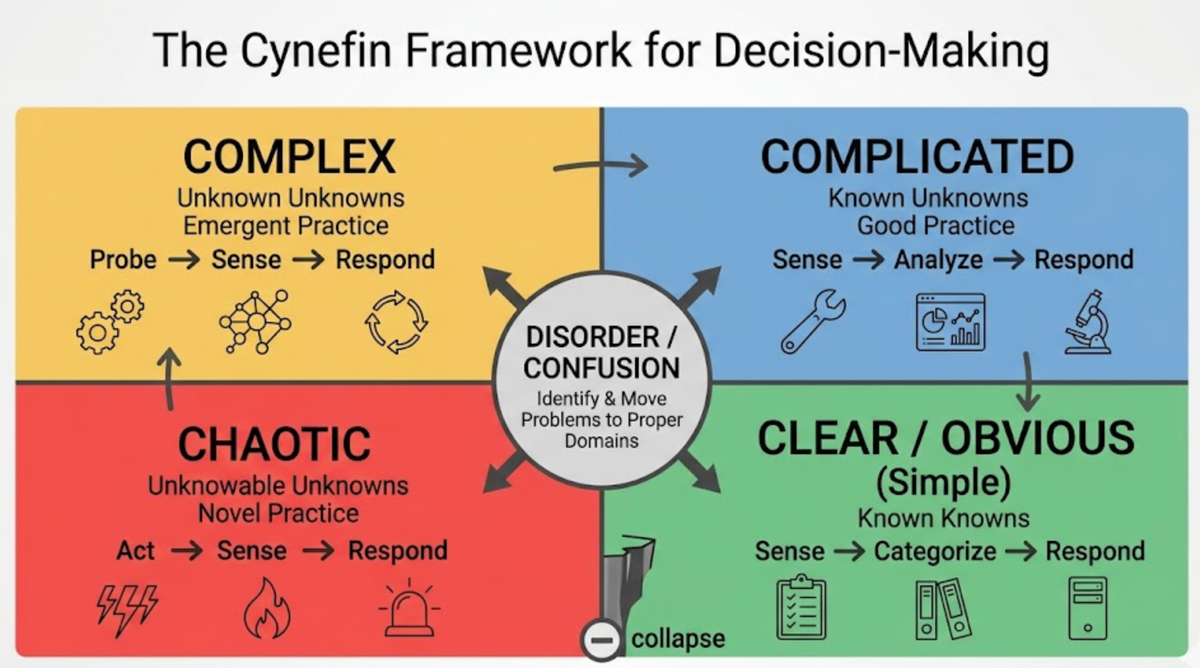
I've spent enough time breaking things in production to know that understanding your environment is half the battle. As engineers, we desperately want everything to have a clear cause and effect. If A, then B. But reality rarely maps cleanly to a perfectly designed architecture diagram. That's why I keep coming back to the Cynefin framework - a mental model that completely changed how I deal with late-night outages and team dynamics.
Making sense of the mess
Cynefin (pronounced kuh-nev-in) is Welsh for 'habitat'. Dave Snowden built the framework in 1999 to help people categorize problems before actually trying to solve them. It stops you from blindly throwing rigid corporate processes at totally unknown situations. Instead, it breaks reality down into five spaces: clear, complicated, complex, chaotic, and confusion.
The clear domain: Checklist territory
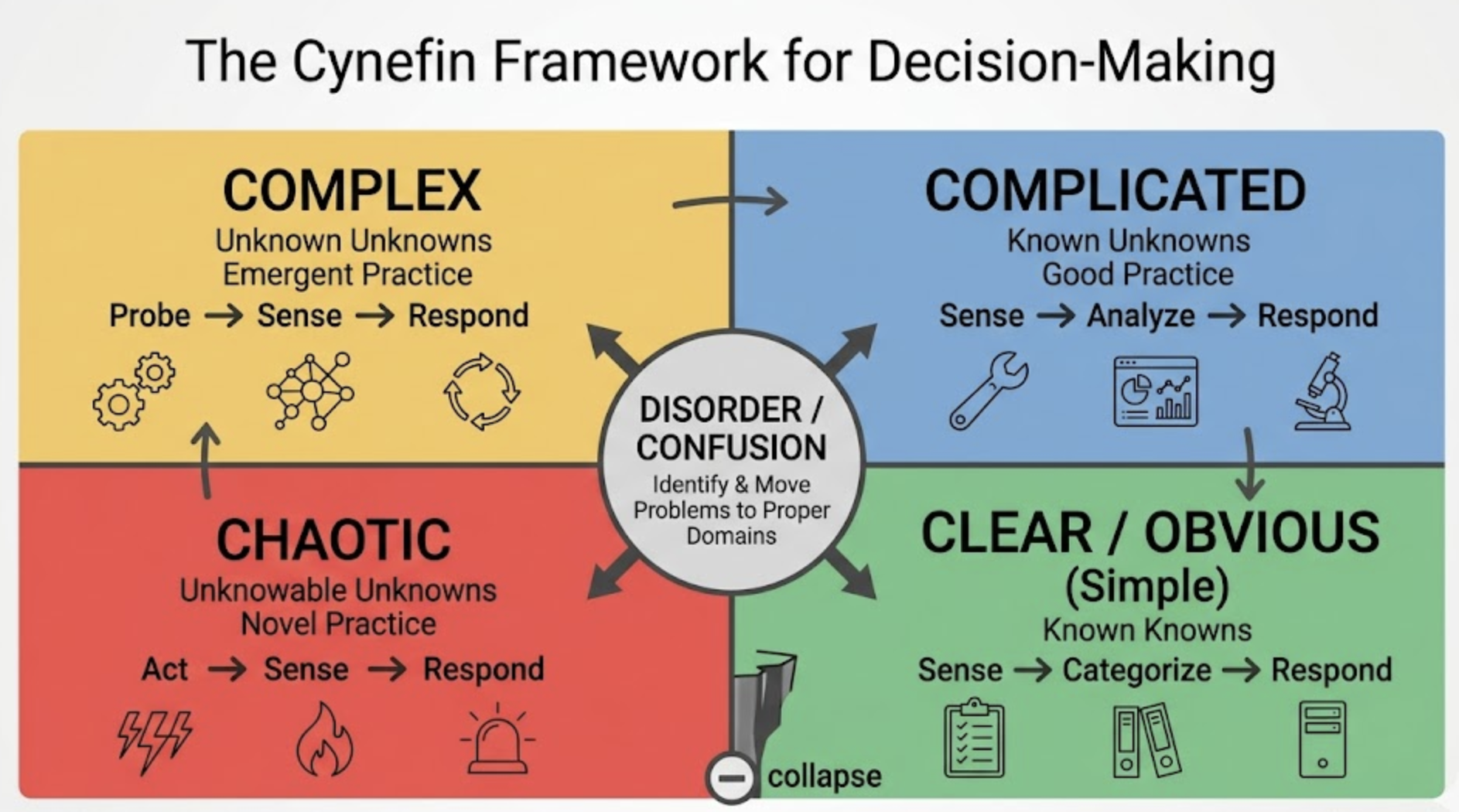
Here, cause and effect are obvious. You follow a simple algorithm: sense, categorize, respond. Think of resetting a user's password or running a standard database migration from a runbook you've used fifty times. You don't need to be creative. You just do the work.
The complicated domain: Call the experts
This is where the known unknowns live. Cause and effect still exist, but they're buried deep in the system. There is no single "right" answer - just trade-offs. You have to analyze before you respond. When you're arguing about migrating a monolith to microservices or tracking down a brutal memory leak, you're in the complicated domain. You lean on experience, look at the options, and pick a path.
The complex domain: The home of agile
Most software engineering happens right here. These are the unknown unknowns. You cannot predict how users will actually use a feature until you put it in their hands. You only understand why a decision worked in hindsight. The rule here is probe, sense, respond. Basically, run an experiment. This is why we work in short sprints and ship early - you build a tiny piece, see what catches fire, and adjust.
The chaotic domain: Production is down
It's 3 AM, the primary database is gone, and none of your alerts fired. You are in the chaotic domain. There is no time to form a committee or write a post-mortem. Cause and effect don't matter right now. Your only goal is to stop the bleeding so you can move the problem back into a manageable space. Act first, apologize later.
Confusion and the Black Swan
The center of the model is confusion - the danger zone where you don't even know what kind of problem you're dealing with. This is usually where managers try to fix deeply complex human issues with rigid, bullet-point policies.
The scariest part of Cynefin is the border between "clear" and "chaotic". It's a cliff. If you get too comfortable relying on routine in a stable environment, a single unhandled exception can drop your entire system into chaos. Nassim Taleb calls these unpredictable extremes "Black Swans". Knowing you operate near that edge is exactly why we have to build antifragile systems.
Happy categorizing!