PostgreSQL lock timeouts strike during long migrations and complex transactions. How lock_timeout and statement_timeout actually work, quick fixes at the database role level, managing timeouts in Rails migrations, and global protection with StrongMigrations.
Measuring developer productivity with one metric backfires: lines of code and commit counts create misleading incentives. The SPACE framework tracks five dimensions (satisfaction, performance, activity, collaboration, efficiency) for an honest picture of a team.
Effective communication in tech teams starts with context: "the payment module shows timeout errors" beats "it's broken". Communication styles, framing, active listening techniques, common pitfalls, and how clear messages build trust with your team.
Enforce consistent commit messages with a small Ruby script and Lefthook: a commit-msg hook that reads .git/COMMIT_EDITMSG, validates prefixes like feat, fix, or docs against a regex, and rejects bad messages before they land. Full script and Lefthook config included.
Genetic algorithms meet Ruby Ractors: a script that repaints Lady with a Weasel generation by generation. Follow the full lifecycle (mutation, fitness scoring, crossover), see how Ractor parallelism speeds up scoring specimens, and view the final result.
Selenium::WebDriver::Error::ScriptTimeoutError in Capybara system tests often appears after a Chrome driver update, and the culprit is default_max_wait_time set to zero for non-headless debugging. Why the error happens and the one-line config change that fixes it.
Pattern matching in Ruby turns case statements into a precise switch over data shapes: match and destructure hashes from an API response, combine several patterns in one branch, capture values across patterns, and validate configuration. Ruby 2.7+ syntax examples.
Slow test suites usually hide a few expensive tests. Minitest and RSpec both ship a built-in profiler: bin/rails test --profile and rspec --profile 10 list your slowest examples with execution times, so you know exactly which tests to optimize first.
TypeScript types with many optional fields need comments to explain what goes together. Discriminated unions fix that: split a Task type into per-status variants so invalid combinations fail to compile and the type documents itself. Before and after code included.
Monolith, microservices, or serverless? A side by side comparison of how each backend architecture handles scaling, development speed, deployment, and cost, where each one breaks down in practice, and a summary that helps you pick the right fit for your project.
XML support in Grape API takes two steps: register the additional content_type so endpoints accept and return application/xml, then change the root element name of the XML output. Complete Ruby examples built around a products endpoint you can adapt to your API.
Database pagination goes beyond LIMIT and OFFSET: ROW_NUMBER(), the FETCH clause, and keyset pagination each behave differently as tables grow. SQL examples for every approach, why offsets get slow on big datasets, and a verdict on which method scales best.
Database sharding in Rails step by step: create a separate database per shard, wire them up in database.yml, and query across them. Plus how sharding differs from partitioning, with a native PostgreSQL partitioning example done through Rails migrations.
Generic types in TypeScript let one function, class, or interface work safely with many data types. What generics are, how a type parameter beats hardcoding a concrete entity type in a validation helper, and honest pros and cons before you use them everywhere.
Domain Driven Design in Ruby with a working example: aggregates, entities, value objects, and repositories built around a ProductCatalog, then extended with event-driven design and event sourcing, where projections rebuild state from events instead of a database.
Rails locking strategies for concurrent updates: optimistic locking with a lock_version column that works out of the box, pessimistic locking with lock! and with_lock, and practical ways to rescue and resolve the StaleObjectError that optimistic locking raises.
TypeScript enums generate extra JavaScript at compile time and numeric enums are not even type-safe. Why enums can hurt bundle size and correctness, and two safer alternatives: assigning explicit string values or replacing enums with plain objects.
Ruby has four ways to load code and each behaves differently: load re-executes a file every time, autoload waits until first use, require loads once from the load path, require_relative resolves from the current file. Examples plus a summary of when to use each.
Ruby 3.2 runs in the browser through WebAssembly: embed Ruby in a script tag with ruby-wasm-wasi or drive the Ruby VM from JavaScript and mix it with HTML. Working examples plus honest limits: no threading or networking, and no extra gems without a custom wasm image.
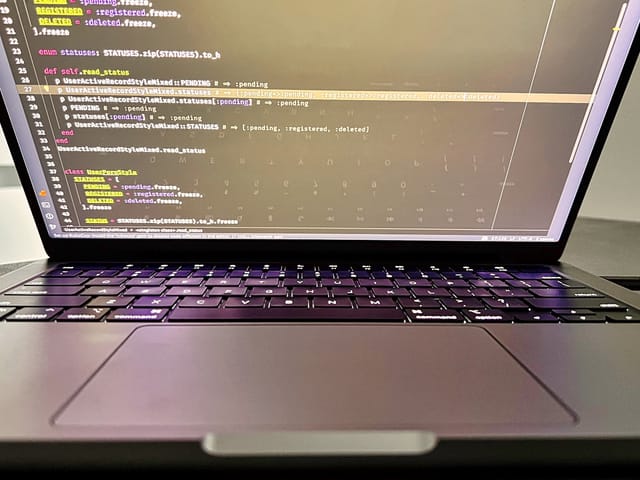
Three ways to define constants and enums per class in Ruby: the ActiveRecord enum macro, a mixed style combining frozen constants with enum, and a dependency-free PORO version. Code for each solution and a comparison to help you pick the right one.
The Factory Pattern in Ruby, then a step further: using naming conventions and regular expressions so the factory auto-detects which notification class to instantiate. Complete code for both versions, plus when strict class listing is the safer choice.
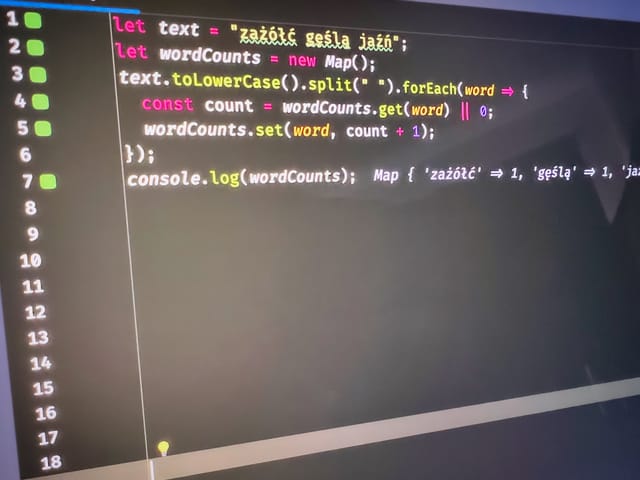
Map vs WeakMap in JavaScript comes down to keys and memory: WeakMap only accepts object keys and lets garbage collection reclaim unused entries, while Map holds onto everything. Differences, similarities, and practical guidance on when each one is the right choice.
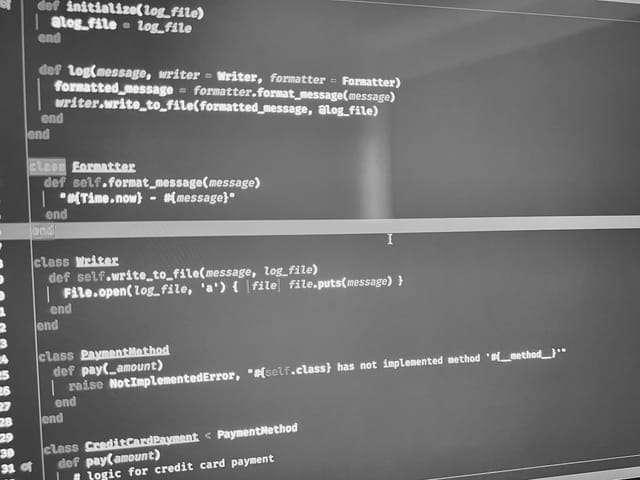
SOLID in Ruby with working code for every principle: Single Responsibility, Open-Closed, Liskov Substitution, Interface Segregation, and Dependency Inversion, plus a bonus rule on minimizing nesting and a fair look at the criticisms of SOLID.
 postgres