Pattern matching in Ruby turns case statements into a precise switch over data shapes: match and destructure hashes from an API response, combine several patterns in one branch, capture values across patterns, and validate configuration. Ruby 2.7+ syntax examples.
Rails locking strategies for concurrent updates: optimistic locking with a lock_version column that works out of the box, pessimistic locking with lock! and with_lock, and practical ways to rescue and resolve the StaleObjectError that optimistic locking raises.
TypeScript enums generate extra JavaScript at compile time and numeric enums are not even type-safe. Why enums can hurt bundle size and correctness, and two safer alternatives: assigning explicit string values or replacing enums with plain objects.
Ruby has four ways to load code and each behaves differently: load re-executes a file every time, autoload waits until first use, require loads once from the load path, require_relative resolves from the current file. Examples plus a summary of when to use each.
Ruby 3.2 runs in the browser through WebAssembly: embed Ruby in a script tag with ruby-wasm-wasi or drive the Ruby VM from JavaScript and mix it with HTML. Working examples plus honest limits: no threading or networking, and no extra gems without a custom wasm image.
Three ways to define constants and enums per class in Ruby: the ActiveRecord enum macro, a mixed style combining frozen constants with enum, and a dependency-free PORO version. Code for each solution and a comparison to help you pick the right one.
The Factory Pattern in Ruby, then a step further: using naming conventions and regular expressions so the factory auto-detects which notification class to instantiate. Complete code for both versions, plus when strict class listing is the safer choice.
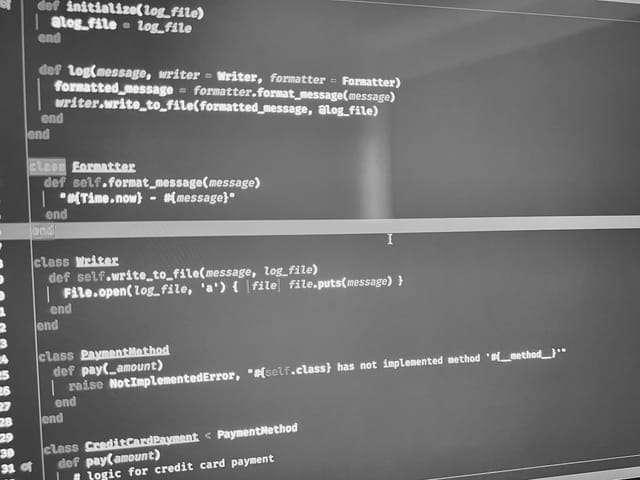
SOLID in Ruby with working code for every principle: Single Responsibility, Open-Closed, Liskov Substitution, Interface Segregation, and Dependency Inversion, plus a bonus rule on minimizing nesting and a fair look at the criticisms of SOLID.
Ruby 3.2 adds new syntax for anonymous arguments: forward positional and keyword arguments with bare * and ** and unpack them inside the method, no more digging through kwargs hashes. A before-and-after example shows how much cleaner argument passing gets.
 ruby
ruby