ETags let browsers skip downloading content that has not changed. What entity tags are in HTTP, then the Rails caching toolkit: stale?, fresh_when, expires_in, expires_now, public requests, and http_cache_forever, each shown with a concrete controller example.
The Singleton pattern in Ruby, shown two ways: a hand-rolled class using private_class_method :new with a self.instance accessor, then a cleaner refactor with the built-in Singleton module. What the pattern guarantees and when one shared instance is worth it.
ACID stands for Atomicity, Consistency, Isolation, and Durability: the four guarantees behind reliable database transactions. Each property explained with a concrete Rails example, like wrapping a money transfer in a transaction so it fully succeeds or rolls back.
Instance variables versus class variables in Ruby: what @ and @@ actually mean, why an @ variable set at the class level stays empty when read from an instance, and how @@ values are shared by every instance. Short code samples make each behavior easy to verify.
cattr_accessor, mattr_accessor, and the thread_cattr and thread_mattr variants explained: ActiveSupport helpers for class-level and module-level attributes, plus thread-safe versions that avoid data inconsistencies in multi-threaded apps. Examples for each accessor, reader, and writer.
Extend, prepend, and include in Ruby each add module code to a class differently: prepend puts the module before the class so its methods win, extend adds class methods, include adds instance methods. Short runnable examples show how each changes the method lookup chain.
Blocks, procs, and lambdas in Ruby all wrap code you can pass around, but they differ in how they check arguments and handle return. Implicit and explicit blocks with yield, building reusable procs, and when a lambda is the safer pick, all shown with runnable examples.
class_eval, instance_eval, and instance_exec power Ruby metaprogramming: reopening classes, running blocks inside an object, and passing arguments in. All explained through one MyWebServer class with a configure DSL, ending in a reusable AppConfig settings pattern.
Ruby hash destructuring can feel as smooth as JavaScript: the rightward pattern matching syntax extracts values from a hash in one line, renames them, destructures arrays, groups elements, and rebuilds hashes afterwards. Practical examples for cleaner Ruby code.
Pattern matching in Ruby turns case statements into a precise switch over data shapes: match and destructure hashes from an API response, combine several patterns in one branch, capture values across patterns, and validate configuration. Ruby 2.7+ syntax examples.
Slow test suites usually hide a few expensive tests. Minitest and RSpec both ship a built-in profiler: bin/rails test --profile and rspec --profile 10 list your slowest examples with execution times, so you know exactly which tests to optimize first.
Monkey patching in Ruby without global damage: why reopening a class like DateTime directly backfires, how prepend and include change the ancestor chain safely, and how refine limits your patch to a single scope so the rest of the codebase stays untouched.
XML support in Grape API takes two steps: register the additional content_type so endpoints accept and return application/xml, then change the root element name of the XML output. Complete Ruby examples built around a products endpoint you can adapt to your API.
Running shell commands from Ruby: system, backticks, exec, the IO class, spawn, and Open3.popen3 compared with pros and cons, from quick one-liners to capturing stdout, stderr, and exit status, so you can pick the right method for scripts and production code.
Database pagination goes beyond LIMIT and OFFSET: ROW_NUMBER(), the FETCH clause, and keyset pagination each behave differently as tables grow. SQL examples for every approach, why offsets get slow on big datasets, and a verdict on which method scales best.
Database sharding in Rails step by step: create a separate database per shard, wire them up in database.yml, and query across them. Plus how sharding differs from partitioning, with a native PostgreSQL partitioning example done through Rails migrations.
Domain Driven Design in Ruby with a working example: aggregates, entities, value objects, and repositories built around a ProductCatalog, then extended with event-driven design and event sourcing, where projections rebuild state from events instead of a database.
Rails locking strategies for concurrent updates: optimistic locking with a lock_version column that works out of the box, pessimistic locking with lock! and with_lock, and practical ways to rescue and resolve the StaleObjectError that optimistic locking raises.
Rails eager_load, includes, preload, and joins each fight slow queries differently: LEFT OUTER JOIN versus separate queries, how includes picks its strategy, and when a plain joins is enough. Clear examples showing which loading method to choose for each situation.
Ruby has four ways to load code and each behaves differently: load re-executes a file every time, autoload waits until first use, require loads once from the load path, require_relative resolves from the current file. Examples plus a summary of when to use each.
Ruby 3.2 runs in the browser through WebAssembly: embed Ruby in a script tag with ruby-wasm-wasi or drive the Ruby VM from JavaScript and mix it with HTML. Working examples plus honest limits: no threading or networking, and no extra gems without a custom wasm image.
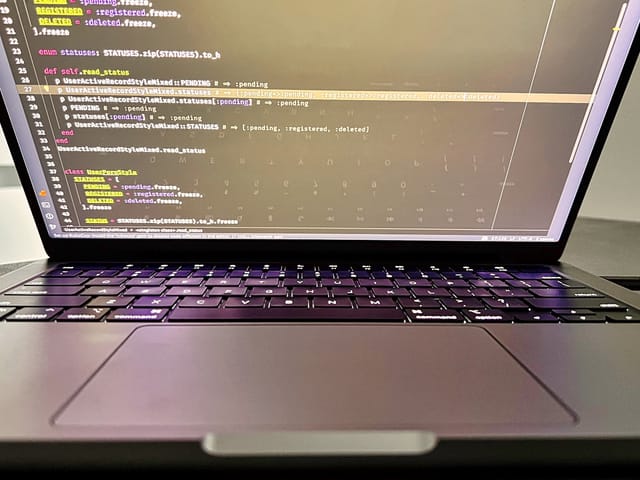
Three ways to define constants and enums per class in Ruby: the ActiveRecord enum macro, a mixed style combining frozen constants with enum, and a dependency-free PORO version. Code for each solution and a comparison to help you pick the right one.
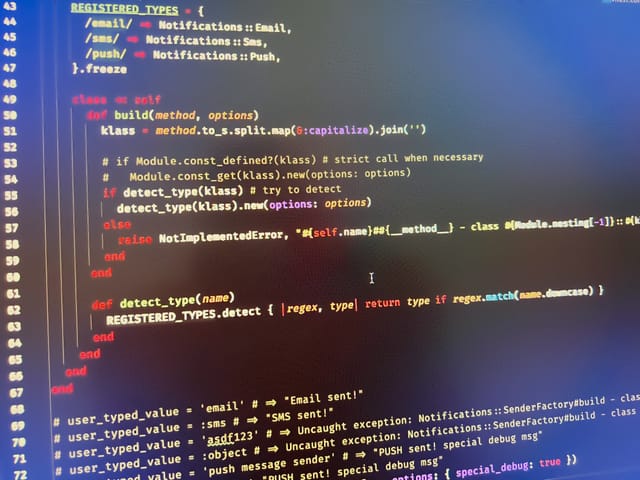
The Factory Pattern in Ruby, then a step further: using naming conventions and regular expressions so the factory auto-detects which notification class to instantiate. Complete code for both versions, plus when strict class listing is the safer choice.
 ruby
ruby