ActiveJob::Continuable lets long-running Rails jobs survive restarts: split work into steps, track progress with cursors and checkpoints, and resume exactly where the job stopped. Covers error handling, queue adapter support, and a practical example.
Rails console tricks that speed up debugging: silence SQL logs, reuse the last result with underscore, inspect routes and schema, find where a method is defined, run rake tasks and raw SQL, time operations, and several more you probably haven't used yet.
Custom RuboCop cops let you enforce your project's own conventions. Step by step: how cops inspect the abstract syntax tree, writing a cop that bans hardcoded phone numbers, wiring it into your RuboCop config, and watching it flag offenses in action.
YAML config files don't have to end up as messy nested hashes. Turn them into real Ruby objects with validation and custom methods: a small model class that loads the YAML, exposes clean accessors, and grows with your Rails app's configuration needs.
PostgreSQL trigram similarity finds records despite typos: enable pg_trgm, run similarity queries from Rails, tune the threshold, order results by score, and wrap it all in a reusable scope. Great for fuzzy search and duplicate detection without external tools.
Reproducible randomness in Ruby sounds like a contradiction, but seeds make it easy: how pseudo-random generators work, fixed seeds for tests, debugging, and procedural generation, creative ways to pick seeds, and the pitfalls that quietly break determinism.
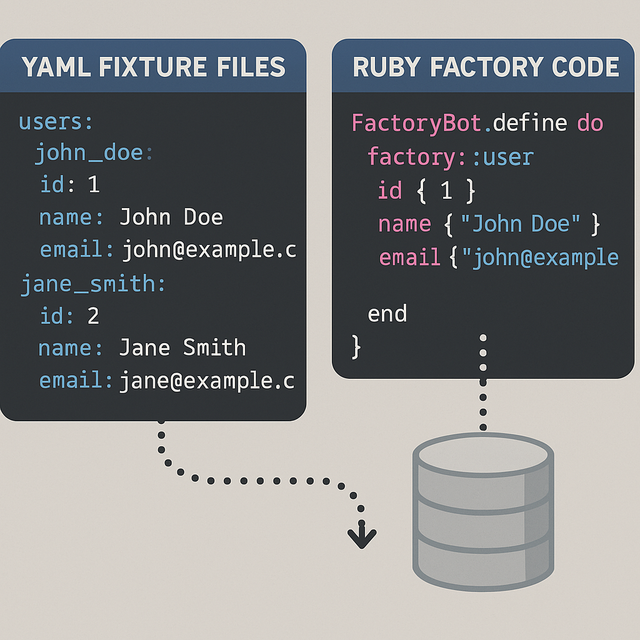
Fixtures or factories for Rails tests? How each approach works: static YAML data Rails loads before every run versus FactoryBot objects built on demand, with examples and clear guidance on when speed favors fixtures and flexibility favors factories.
Turbo prefetching loads pages on hover, which is great until links point at heavy reports or expensive queries. How the data-turbo-prefetch attribute works, disabling it globally or per link in Rails, and when selective prefetching saves your server.
FactoryBot traits can nest other traits, letting you compose reusable test fixtures instead of copying attribute blocks. A quick refresher on traits, then the traitception pattern: defining traits inside traits and combining them for cleaner Rails test setup.
The :environment dependency in Rake tasks is what loads your Rails app, models, and database connections. What task my_task: :environment actually does behind the scenes, how the Rake dependency syntax works, and why skipping it breaks your custom tasks.
OJ speeds up JSON in Ruby, but Oj.mimic_JSON silently drops the script_safe option, opening the door to XSS, and adds time precision quirks. What its monkey patching really changes, the stability risks, and best practices for using OJ without surprises.
params.expect in Rails 8 replaces require/permit and fixes a real weakness: crafted params like ?user=string used to raise NoMethodError and 500 errors. How the new syntax works, how it handles arrays with precision, and how to migrate your controllers.
Custom RSpec matchers turn repetitive assertions into readable, reusable specs. Step by step: define a matcher with RSpec::Matchers.define, add clear failure messages, build flexible matchers that take arguments, and wire them into your Rails test suite.
Ruby 3.4 adds the new 'it' block parameter that makes .then chains and maps cleaner than numbered parameters, chilled strings as a step toward immutability, and enhanced Range operations. What each change looks like in practice, with before and after code.
Rate limiting in Rails 8 is built in: the rate_limit method declares limits per controller and action, like 3 requests per 2 seconds on create. How to combine short and long windows, protect unsafe actions, and practical suggestions for sensible limits.
Database enums in PostgreSQL give Rails apps type safety, implicit ordering, and faster queries than string columns. Single-value enums with validation, multi-select enum arrays, dynamic enum management, and the migrations that wire it all together.
Rails console sandbox mode wraps every database operation in a transaction and rolls it all back on exit, so you can experiment safely. How to launch it, plus the traps: database locking, non-rollbackable operations, and why production use still needs care.
Legacy services with mismatched method names (validate, execute!, run!) can be unified with Ruby method objects. How to build one dispatcher that calls the right method on each class, why it beats conditionals, and what it does for readability.
Frugal Architecture is Werner Vogels' framework for cost-conscious system design: three pillars (Design, Measure, Optimize) and seven laws, from treating cost as a non-functional requirement to continuous optimization, explained with practical examples.
ActiveSupport::Notifications lets you listen to Rails events like transaction.active_record without extra gems. How the instrumentation API works, subscribing to built-in Rails events, and publishing your own custom events for better observability.
Colored terminal output in Ruby takes a few lines: extend String with ANSI escape methods like red, green, and bold, add colorized logging to the Rails logger, or reach for a gem when you need more. Copy-paste snippets for scripts and console logs.
Upgrading PostgreSQL from 16 to 17 in Docker without losing data: run both versions side by side in docker-compose, back up with pg_dump, restore into the new container, then switch the app over. Five concrete steps plus the gotchas to watch out for.
HTTPS for local iOS development with mkcert: generate a local certificate authority, create SSL certificates for your dev domains, and install the root certificate on a simulator or real device so Safari and your native app trust your local Rails server.
 ruby
ruby