Generation got a hundred times faster and reading did not. What that actually breaks in code review, why spec-driven development collapses into a compiler, why clean code matters more when agents read it, and what to build instead: an ontology of your own development process.
Basecamp's Campfire, unchanged, compiled to one native binary: 5x the throughput on 366 MB instead of 4.6 GB. How Roundhouse lowers Rails, how Matz's Spinel compiler turns that Ruby into C, which Ruby constructs it refuses, and how far you can push it on your own app today.
Jev, TypeSafe's System One model, returns typed decisions with calibrated probabilities in 70-500ms instead of generating text. Here is what the "cannot hallucinate" claim actually guarantees, where it breaks in production, a forty-line Ruby client, and how to test it on your data.
YouTube runs the biggest recommendation feed on the planet, and it does not win with rules. See how its homepage ranks on satisfaction instead of clicks, learns per user, and trusts reactions, then how to build the same ideas into your own app with Ruby and SQL.
Refactoring a live monolith is a risk problem, not a style problem. A strategy built on real pain points: modular monolith boundaries enforced by tools, boring rollbacks, avoiding the three-week refactoring branch, and saving the expensive decision for last.
Messaging looks clean on a diagram and gets messy in production. Duplicate messages, slow consumers, fat events, DLQs used as trash cans: what each problem really costs and the patterns (idempotency, event design, async UX) that keep a broker-based system honest.
21 engineering lessons that survive contact with production: why simple code beats clever code, technical debt as a communication problem, what actually builds trust in teams, and how senior engineers pick problems. Field notes for real teams, not conference slides.
Technical debt is not the real enemy: cognitive load is. Why messy abstractions hurt because of what they do to your brain, how the database quietly kills flow, and how to stop chasing code cleanliness for its own sake and start delivering again.
OpenAI serves over 800 million weekly ChatGPT users without database sharding. Inside the architecture: a single primary PostgreSQL, cascading read replicas, aggressive caching against thundering herds, and connection pooling pushed to its limits.
Zanzibar is how Google authorises billions of shared resources across Drive, YouTube and Calendar. A look at its relationship-based data model, the new enemy problem that forces strict consistency, and the Leopard system that keeps checks fast.
Business archetypes prove your 'unique' domain is usually a store selling something unusual. Map complex requirements onto universal building blocks: product catalogue, orders, entitlements, inventory for services, party and billing, and stop reinventing the wheel.
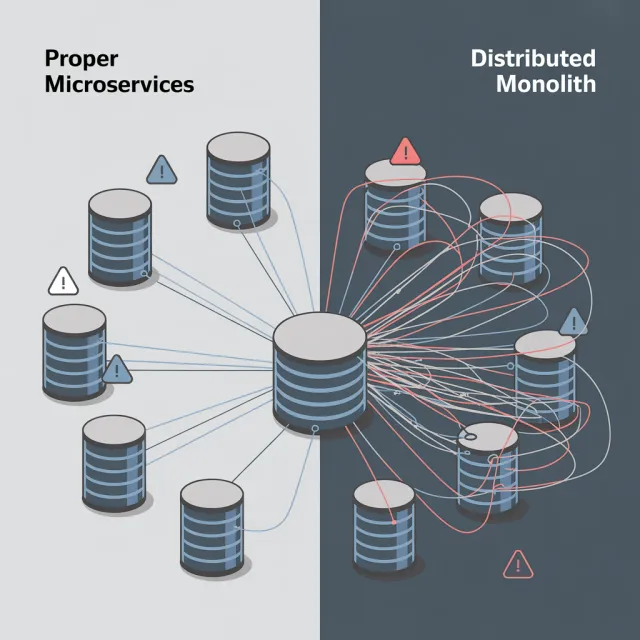
A distributed monolith is what you get when microservice boundaries are drawn wrong. How to design autonomous modules in three phases: business analysis for boundaries, tight communication contracts, and deployment decisions driven by real architectural drivers.
CUPID challenges SOLID with properties instead of rules: composable, Unix philosophy, predictable, idiomatic, domain-based. Where the decades-old principles show their age in the cloud era, what 'joyful software' means, and whether SOLID is really done.
Race conditions in read models are the price of parallel event-driven systems. How to handle events arriving out of order: treat the read model as an anti-corruption layer, separate facts from rumours, and build projections that survive an effect arriving before its cause.
Siamese twin modules force a change in one place to ripple into another. How domain leakage and state-transfer events create a distributed monolith, and how contextual modularization with the right communication patterns cuts the connection, without cargo cult.
Architectural Kata is a flight simulator for system design: practice big architecture decisions in a safe setting instead of waiting years for a greenfield. How a kata session works, six perspectives that change the outcome, and why architecture is communication.
Microservices vs monoliths is a trade-off, not a dogma. Why companies really migrate (team coordination, not speed), the complexity bill that follows, what DoorDash's transformation shows, and how to pick architecture on evidence instead of fashion.
Evolutionary architecture treats change as a design input, not a threat. Why rigid paradigms fail, how to make well-informed architecture decisions, and how identifying architectural drivers and writing fitness functions keeps your system resilient.
Hexagonal Architecture separates your business logic from databases, UIs, and external services using ports and adapters. What the pattern really means, a practical Ruby implementation, when it pays off, and the common problems teams hit when adopting it.
Living documentation stops going stale with the P3 model: define the Purpose (why you document), the Process (how it stays current), and the Product (what readers get). A practical framework for engineers tired of outdated wikis and misleading docs.
Frugal Architecture is Werner Vogels' framework for cost-conscious system design: three pillars (Design, Measure, Optimize) and seven laws, from treating cost as a non-functional requirement to continuous optimization, explained with practical examples.
Coupling in distributed systems goes far beyond shared code: technology, location, semantic, data format, conversation, topology, order, and temporal coupling each hurt resilience differently. What every type looks like and how to keep services independent.
 ai
ai